
TDCJ Waller Release Paths
A Waller County defendant committed to TDCJ enters a statewide prison system. Classification, sentence structure, program needs, and available placement determine the unit. The unit holding the person is not a proxy for county of conviction or future release destination. TDCJ reports multiple release sites and seeks to use sites near the legal county of residence when possible, but release may also go to an approved community plan or directly to a detainer.
| Outcome | Meaning | Best proof |
|---|---|---|
| Full discharge | State sentence ends | Actual release/discharge record |
| Parole | Community custody for the remaining sentence | IVSS event and Parole Division assignment |
| Mandatory supervision | Statutory supervised release when applicable | TDCJ release and supervision record |
| Detainer transfer | Another agency receives custody | Release destination and receiving agency |
Confirm TDCJ Waller Releases
Open the official TDCJ offender search. An eight-digit TDCJ number or SID gives the strongest search. Name searching remains available, but identity should be checked with descriptors and offense history.
- Search by TDCJ number, SID, or full name.
- Review location, offenses, projected release date, and parole-review fields.
- Open IVSS and locate the same person by name or identifier.
- Distinguish Expected Release Date from actual Release Date.
- For older proof, request the release certificate and discharge type from Classification and Records.
The Waller County released inmate search explains when a county booking record must be reconciled with the later state record.
TDCJ Release Records Contact
TDCJ Classification and Records handles inmate time, transfers, and releases. Contact 936-437-6231 or classify@tdcj.texas.gov. A formal Public Information Act request may use the online TDCJ form, PIA@tdcj.texas.gov, or mail to TDCJ Public Information Request, PO Box 4017, Huntsville, TX 77342. Hand delivery is accepted at 2 Financial Plaza, Suite 600, Huntsville, TX 77340.
Ask for the actual release or discharge date and type, release certificate, sentence and offense record, destination or detainer notation, and releasable identification or photo record. A current search is not promised as a full archive of every fully discharged former inmate.
TDCJ Units Serving Waller
The official unit directory identifies no TDCJ unit in Waller County. Search by person, not by guessing a nearby prison. A Waller judgment committing someone to TDCJ establishes state authority, while the state search identifies the current unit and projected date.
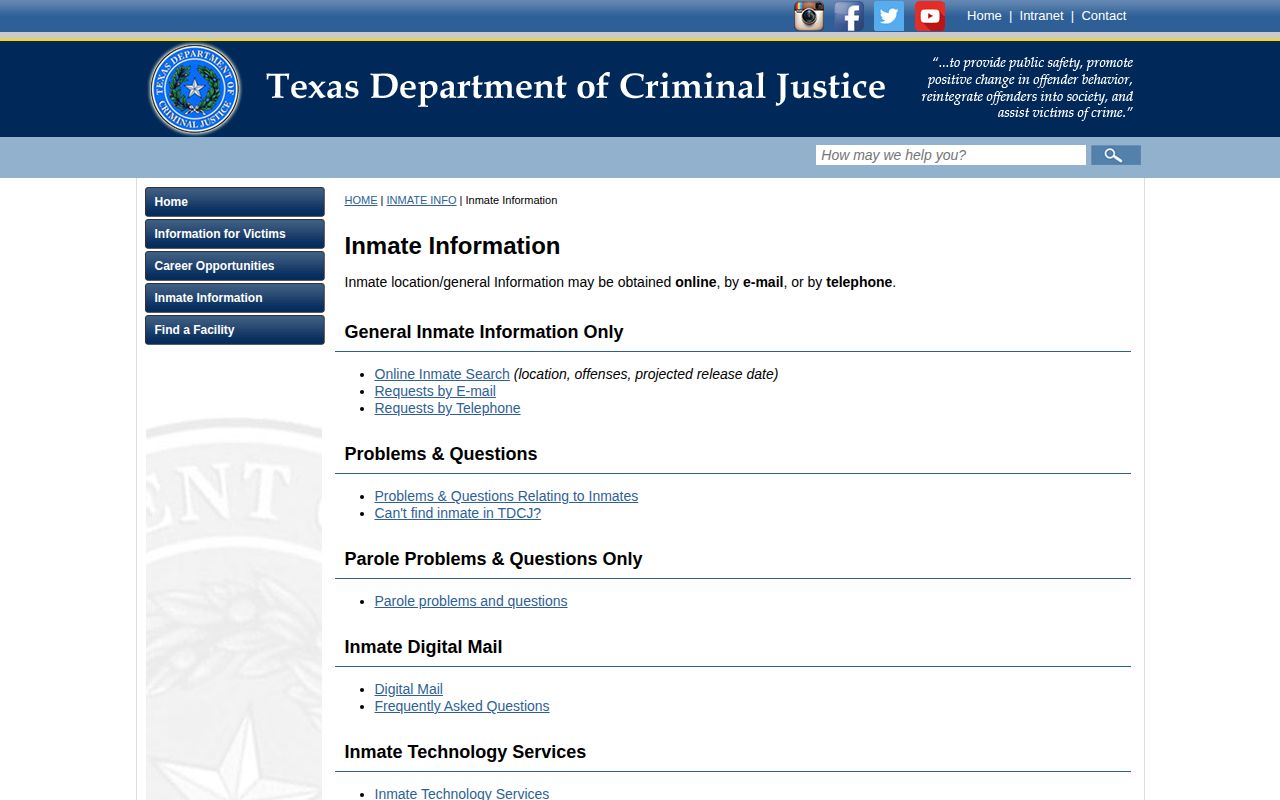
The offender-information page documents the fields and scope available through TDCJ.
This state source, not the Waller current jail roster, controls the state-prison episode.
TDCJ Projected Versus Actual Release
TDCJ calls its planning field projected release date. IVSS calls the related planning field Expected Release Date and may show actual Release Date after release. Sentence correction, good-conduct classification, discipline, parole action, mandatory-supervision eligibility, detainers, new sentences, or court action can change the estimate.
A favorable parole vote can still require a future date or program. Release to parole also leaves the person under TDCJ authority. Full discharge is different.
TDCJ Waller Supervision Records
The Texas Board of Pardons and Paroles makes parole and mandatory-supervision decisions. TDCJ Parole Division supervises those released under state authority. Waller County is assigned to the Conroe District Parole Office, so a post-release office outside the county is expected rather than an error.
IVSS can provide custody and supervision notifications. Its actual Release Date helps confirm the state event, but a county-only detainee does not gain a TDCJ record merely by leaving Waller County Jail.
TDCJ Release Date Rules
Texas has no blanket requirement that every state prisoner serve 85 percent. Government Code section 508.145 applies offense-specific eligibility rules. General cases may combine calendar and good-conduct time, while specified serious or deadly-weapon cases use calendar-time minimums. Section 508.149 excludes listed cases from mandatory supervision.
Government Code section 498.003 treats good conduct time as a privilege, not a right. It can be earned or forfeited and does not guarantee a Board vote or physical release. Read the actual offense, sentence, and applicable law rather than applying a slogan.
TDCJ Identity And Date Matching
Names alone are weak identifiers in a statewide system. A Waller court cause number belongs to the county case, while TDCJ uses a SID and an eight-digit TDCJ number. Copy the exact state identifier from the official result and keep it with the offense and location fields. A middle name, alias, suffix, changed surname, or data correction can split one person's trail across several screens. Do not merge records because names and ages seem close.
Date labels also matter. The Waller booking timestamp begins the county episode. A judgment date may authorize transfer before transport occurs. TDCJ's projected date can change, a Board decision date can precede program completion, and IVSS's actual Release Date records the state event. Label each date with its agency and meaning. This prevents a county transfer date from being presented as a state discharge.
Older TDCJ Waller Discharges
If a fully discharged person no longer appears in the live state tools, request historical proof. Classification and Records can address time calculations, transfers, and releases. A focused request identifies the person by SID or TDCJ number and asks for the actual release or discharge date, release type, release certificate, sentence information, and releasable destination or supervision data.
Public Information Act requests can be narrowed when the first wording is too broad. Electronic copies and acceptance of lawful redactions may reduce delay. A response that confirms release to a detainer should be reported as a transfer of custody, not as unrestricted community release.
TDCJ Parole Decision Limits
Texas does not conduct an ordinary formal parole-consideration hearing with a public statewide calendar. Panels review files and vote in sequence. The offender record's review status, last decision and date, and next review field provide the practical schedule. A decision code is a milestone, not proof that the person passed through a release site.
Some favorable codes authorize release when eligible. Others require a future date or completion of a program. Confirm the later actual Release Date and supervision assignment. For Waller-linked parole, the county directory assigns the Conroe District Parole Office, Region I, at 4301 South Loop 336 East, Conroe, TX 77301, phone 936-756-0420.
Parole and mandatory supervision differ from full discharge because state authority continues in the community. If TDCJ sends the person to a detainer, follow the named receiving agency and avoid describing that transfer as freedom from custody.
TDCJ Good Conduct Calculations
Government Code section 498.003 makes good conduct time a privilege based on classification and participation. TDCJ can forfeit it for misconduct. Program and work participation credit under the statute is capped, and earned credit may affect eligibility calculations without guaranteeing a Board vote, mandatory supervision, or physical release. The controlling sentence, offense, date of offense, classification, and disciplinary record must be applied to the individual state case.
State-jail felonies follow an additional path. TDCJ guidance explains that a sentencing judge may award diligent-participation credit of up to 20 percent in qualifying cases, after which TDCJ recalculates maximum discharge. For qualifying offenses committed on or after the stated statutory date, a judgment may address presumptive entitlement subject to legal conditions. That rule cannot be generalized to an ordinary prison sentence or to a Waller county-jail term.
TDCJ Notification Record Details
IVSS provides a person-specific state path. Search by name, SID, or current or former eight-digit TDCJ number, open the person's details, and compare the Expected Release Date with any actual Release Date. Partial-name wildcard searching is supported. The record may also carry parole review, decision, supervision, warrant, return-to-custody, release, or discharge events. Those fields belong to TDCJ custody and supervision, not to a county-only jail stay.
A user can subscribe after locating the correct person. The registration flow uses an account, verified email, contact methods, and a four-digit PIN for automated phone confirmation. Email, text, letter, and telephone options have different delivery characteristics. Notification is a signal rather than a guarantee of exact timing. Classification and Records remains the route for a release certificate or older historical discharge proof.
When sources conflict, use each agency record only for the custody episode it controls. Ask TDCJ to explain state data rather than changing a Waller court or jail record by inference.
A Waller court commitment order starts the state route but does not identify the final unit, projected date, or release site. Use the unit directory and current offender result for placement, then use IVSS and Classification and Records for the actual state release. If the release record names a detainer, continue with that receiving system.