
Projected and Actual Release Dates
TDCJ calls its planning field a projected release date. IVSS uses Expected Release Date and may later show an actual Release Date. The projected and expected fields are calculations based on the information currently in the state record. They can change. The actual field records a later event, though it still applies only to the TDCJ custody episode.
People held before trial generally have no computed sentence-release date. Their path can turn on bond, court orders, disposition, and other holds. For those cases, use the Waller roster to see current custody, Odyssey to identify court activity, and the sheriff’s release record to prove the completed exit. Do not convert a court setting or bond amount into a promised release date.
Find a Waller Release Date
The correct workflow depends on who holds the person. Waller County Jail, TDCJ, BOP, and ICE maintain separate records. Begin with the court judgment or booking information if the custodian is uncertain.
- Identify the custody system. Check the Waller current roster for county custody. If a judgment committed the person to TDCJ, use the state system even if the case began in Waller County.
- Search TDCJ by official identifier. Open the TDCJ offender search. Use the TDCJ or SID number when possible, then confirm the name and record.
- Read every date label. Distinguish projected release, parole eligibility, review status, decision date, and maximum sentence date. They answer different questions.
- Check IVSS. The state IVSS portal may show Expected Release Date and, after the event, actual Release Date. Match the same SID or TDCJ number.
- Use Waller records for county time. For a county jail sentence or pretrial stay, request the sentence calculation, booking-out time, release authority, release reason, and receiving agency or detainer from the sheriff and court.
- Verify the event. Return after the projected day and look for an actual agency release record. If the person transferred, continue in the receiving system.
The complete Waller County release lookup explains how to request a county booking-out record when no historical public screen exists.
Read TDCJ Release Fields
The TDCJ search is the central official route for a Waller County defendant serving a state sentence, even though the state unit may be far outside Waller County. No TDCJ institution was identified within the county. A statewide placement is normal and does not change which state record controls the calculation.
The offender record can show a projected date and parole-review fields. Read the projected date as the output of current sentence data. A parole eligibility date marks when consideration may become available under the governing law; it is not a release appointment. A favorable Board code may call for a future date or a required program. The maximum sentence date can also differ from each of those milestones.
The official TDCJ offender search illustrates the labels that must remain separate.
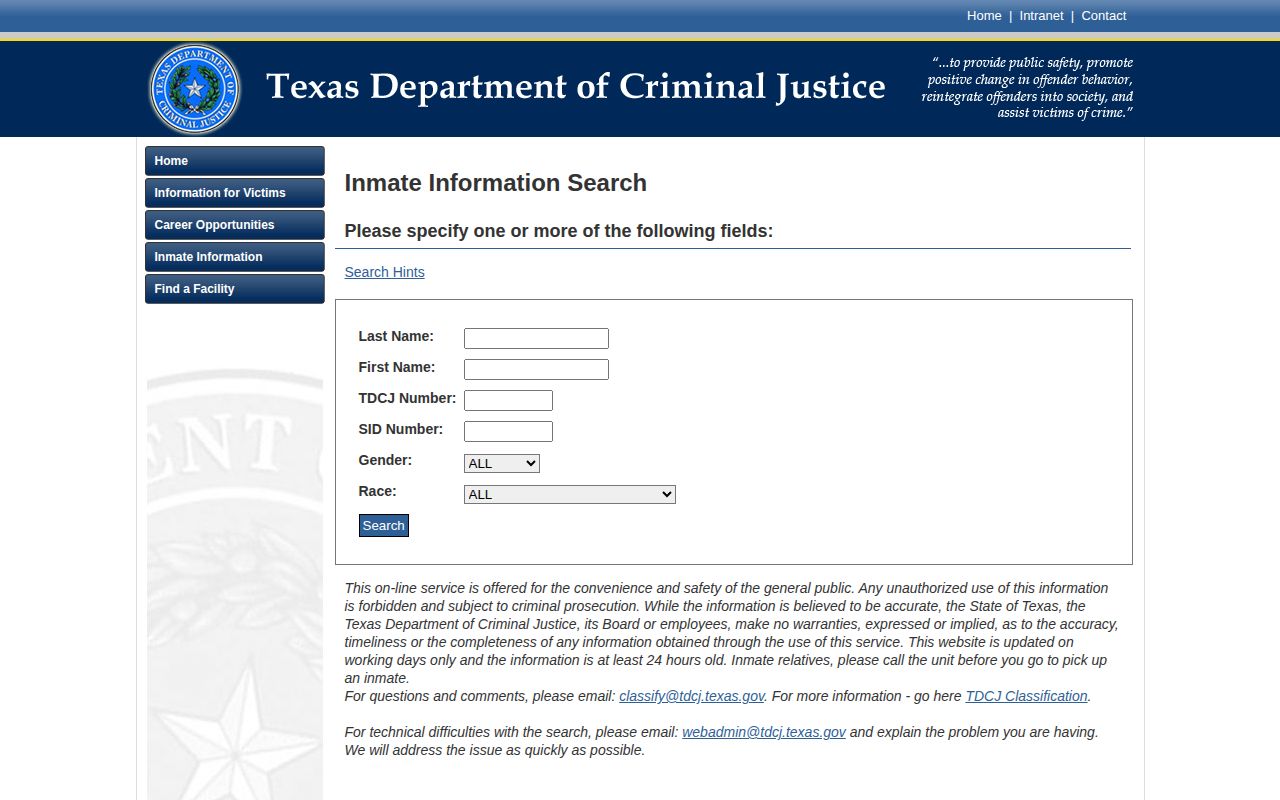
Copy the label with the date when saving information. A date without its TDCJ label can easily be misreported as an actual release.
Why Waller Release Dates Change
State calculations respond to changes in sentence and custody data. Some inputs move the eligibility point; others delay physical release even after a legal milestone has arrived.
| Factor | Possible effect | Where to verify |
|---|---|---|
| Sentence structure | Concurrent or consecutive terms change the controlling calculation | Judgment and TDCJ Classification and Records |
| Jail credit | Credited presentence time changes time calculations | Court judgment and TDCJ record |
| Good-conduct class | Earning rate may affect eligibility calculations | TDCJ time record |
| Disciplinary forfeiture | Loss of good conduct can move a projected milestone | TDCJ disciplinary and time records |
| Parole vote | Approval, denial, future date, or program condition changes the path | Board decision and TDCJ search |
| Mandatory-supervision eligibility | Statutory exclusion or Board denial can prevent expected release | Government Code §508.149 and TDCJ |
| Program completion | Some favorable vote codes require a program before release | Board code and TDCJ status |
| Detainer or new court action | Person may transfer or remain held despite another event | Custodian, court, and receiving agency |
A change is not necessarily an error. Compare the date the record was viewed and the agency scope. An older screenshot may reflect a valid calculation that was later updated.
Does Texas Require 85 Percent?
Texas does not impose a blanket state-prison rule requiring every person to serve 85 percent. This Waller release-date question must be answered with the offense, sentence, offense date, and the applicable subsection of Government Code §508.145.
Under the general framework in §508.145(f) for otherwise eligible people, calendar time plus good-conduct time must equal one-fourth of the sentence or 15 years, whichever is less. Under §508.145(d), specified serious or deadly-weapon cases generally require actual calendar time equal to one-half of the sentence or 30 years, whichever is less. Good time cannot be used to satisfy that calendar minimum. Other subsections create distinct rules or no-parole outcomes.
Mandatory supervision is another calculation. It generally concerns calendar time plus accrued good conduct equaling the sentence, but §508.149 excludes listed offenses and permits review or denial for qualifying cases. Parole eligibility and mandatory-supervision eligibility are not equivalent to an actual release date.
This offense-specific structure is the distinctive Texas answer. A percentage stated without the exact legal category can be badly wrong, and it cannot account for Board action, program conditions, detainers, or later court changes.
Texas Good Conduct Time
Government Code §498.003 treats good conduct time as a privilege, not a right. TDCJ awards it according to classification and participation and may forfeit it for misconduct. Program or work participation credit under subsection (d) is capped at 15 days per 30 days actually served.
State-jail felonies have another narrow rule. TDCJ’s HB 2649 guidance says a sentencing judge may award diligent-participation credit of up to 20 percent, after which TDCJ recalculates maximum discharge. For qualifying offenses on or after September 1, 2015, a judgment may include presumptive entitlement subject to governing conditions. That provision should not be generalized to an ordinary prison sentence.
Waller County Jail Good Time
County jail time is not calculated under the same TDCJ framework. Texas Code of Criminal Procedure article 42.032 permits a sheriff to grant commutation of up to one day for each day actually served for good conduct, industry, and obedience. The statute says the sheriff may grant it, which makes the authority discretionary.
No official Waller County good-conduct policy or public calculation worksheet was found in the reviewed sources. It would be inaccurate to promise automatic two-for-one credit, a specific booking-out hour, or a special weekend adjustment. Ask the Waller County Jail and the sentencing court for the actual calculation, credited days, release authorization, and final booking-out timestamp.
For a pretrial detainee, good-time math does not create a sentence release date because no custodial sentence has yet been imposed. Bond can be posted on one charge while another charge, warrant, or temporary hold remains. The current roster’s disappearance still requires an affirmative release or transfer record.
Confirm Waller Actual Release
After finding a projected date, register for an appropriate notice through the Waller VINE and IVSS guide. Notifications help track change, but the agency record remains the proof source. IVSS may later display actual Release Date for TDCJ; the sheriff can provide a county booking-out or transfer record.
If the event involves parole, note that ordinary Texas parole consideration is an individual file review, not a formal public hearing with a calendar. Decision codes are milestones. FI-2 and several program-conditioned FI codes expressly contemplate a later event. Confirm completion through the state record and the assigned Conroe DPO.
If records disagree, rank each source by the event it owns: the court for judgment and credit, TDCJ for state time calculations, the Board for its vote, the sheriff for county custody, and the receiving agency for a detainer transfer. Often the records describe different points in one sequence rather than a true conflict.
Request Waller Time Records
When an online date does not explain the calculation, request the records owned by each agency. For a Waller case, obtain the judgment and any later order that changes the sentence or credit. Ask the sheriff for the county custody log, credited time used in its calculation, release authorization, actual booking-out time, and any transfer or detainer notation. No public Waller worksheet was found, so the agency response is safer than applying a generic county formula.
For a TDCJ sentence, identify the person with the SID or TDCJ number and direct a historical calculation question to TDCJ Classification and Records or the applicable open-records channel. Ask for the time-related record that explains the displayed projected date, subject to lawful withholding. The court owns the sentence; TDCJ owns the state calculation; the Board owns its parole vote. Keeping those requests separate helps each office locate the record it actually maintains.
Compare every response by date. A judgment can precede TDCJ intake, jail credit can be entered later, and a disciplinary or Board event can change the projection after an earlier search. Consecutive and concurrent terms also affect which sentence controls. A newer projected date does not erase the older calculation; it usually means an input changed.
Finally, ask for the event record after the expected day. A TDCJ actual Release Date or a Waller booking-out entry answers a different question from the calculation material. If the record shows release to another agency, describe it as a transfer from that custodian. Do not turn the end of one agency episode into a claim that all custody ended.